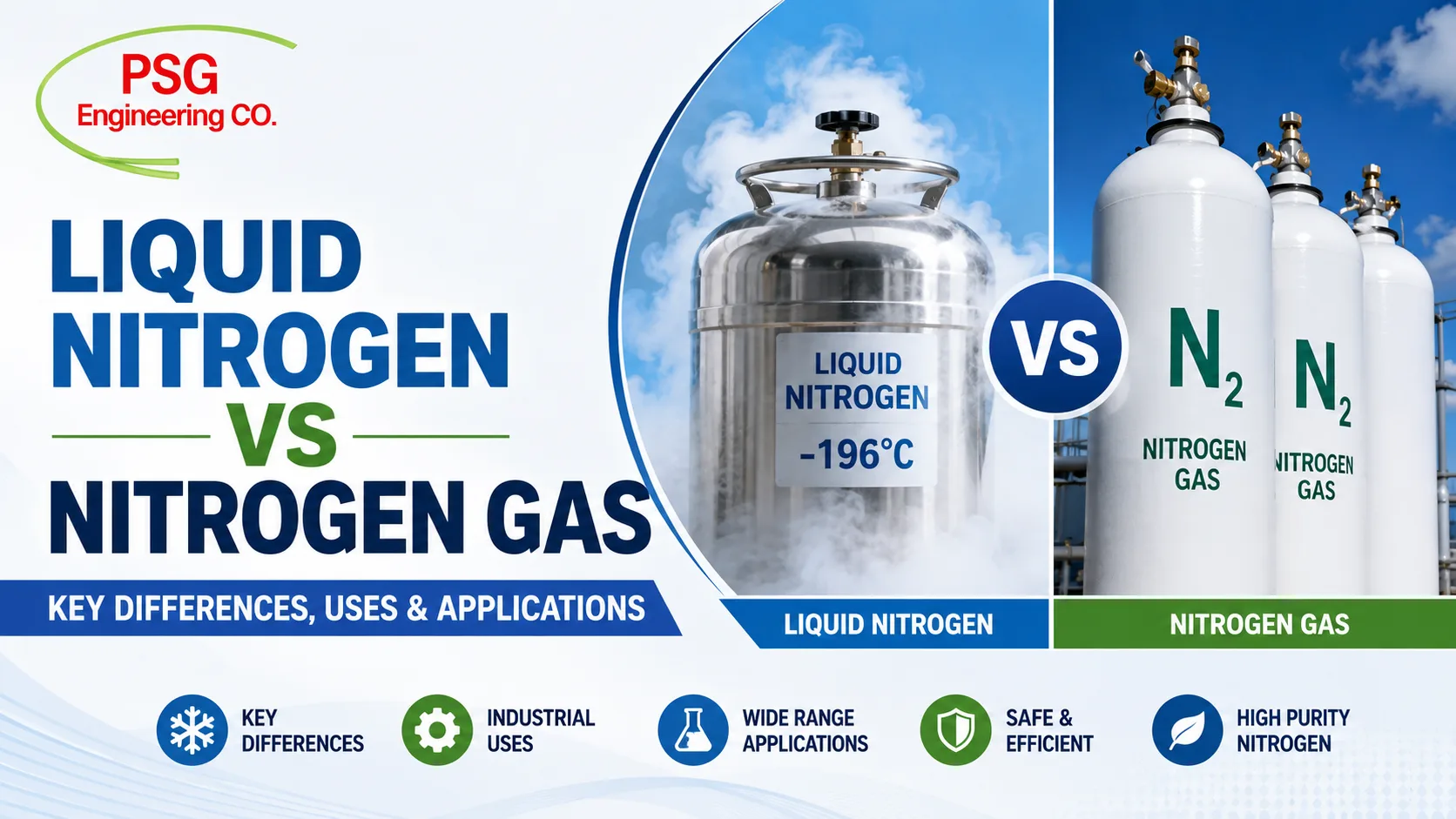
Nitrogen is one of the most widely used industrial gases due to its unique properties, including being colorless, odorless, and non-reactive. It is used across various industries such as pharmaceuticals, food processing, chemicals, electronics, metal processing, and healthcare.
Nitrogen is mainly available in two forms: liquid nitrogen and nitrogen gas. Although both forms contain the same nitrogen molecules (N₂), their physical properties, storage methods, and applications are different.
What is Nitrogen Gas?
Nitrogen gas is the gaseous form of nitrogen that makes up approximately 78% of the Earth’s atmosphere. It is commonly generated through Pressure Swing Adsorption (PSA) technology or membrane technology for industrial applications.
Nitrogen gas is mainly used where industries require a controlled supply of inert gas for protection, preservation, and process applications.
What is Liquid Nitrogen?
Liquid nitrogen is nitrogen converted into a liquid state by cooling it to extremely low temperatures (around -196°C). It is stored and transported in specialized cryogenic containers.
Due to its very low temperature, liquid nitrogen is widely used for cooling, freezing, and cryogenic applications.
Temperature of Liquid Nitrogen
Liquid nitrogen (LN₂) is one of the most widely used cryogenic liquids in industrial, medical, scientific, and food processing applications. At standard atmospheric pressure (1 atm), liquid nitrogen has a boiling point of −196°C (77 Kelvin or −320.8°F). This extremely low temperature makes it ideal for rapid cooling, freezing, cryogenic preservation, and industrial manufacturing processes.
Nitrogen is converted into a liquid by compressing and cooling nitrogen gas until it reaches its boiling point. Because of its exceptionally low temperature, liquid nitrogen absorbs large amounts of heat from surrounding materials, making it an efficient cooling medium. As it absorbs heat, it quickly evaporates back into nitrogen gas without leaving any residue or contamination. This property makes liquid nitrogen suitable for industries where cleanliness and precision are essential.
How Cold is Liquid Nitrogen?
Liquid nitrogen exists at an extremely low temperature because nitrogen gas must be cooled significantly before changing from a gas into a liquid. During the liquefaction process, nitrogen molecules lose kinetic energy and condense into liquid form at approximately −196°C. Since nitrogen makes up nearly 78% of Earth’s atmosphere, it is readily available and economical for large-scale industrial use.
Liquid Nitrogen Temperature Chart
| Property | Value |
|---|---|
| Chemical Formula | N₂ |
| Boiling Point | −196°C (77 K / −320.8°F) |
| Freezing Point | −210°C (63 K / −346°F) |
| Appearance | Clear, Colorless Liquid |
| Odor | Odorless |
| Density | Approximately 808 kg/m³ |
Key Differences Between Liquid Nitrogen and Nitrogen Gas
| Feature | Liquid Nitrogen | Nitrogen Gas |
|---|---|---|
| Physical State | Liquid | Gas |
| Temperature | Approximately -196°C | Normal temperature |
| Storage | Cryogenic tanks | Gas cylinders or nitrogen generators |
| Production Method | Air separation and liquefaction | PSA nitrogen plant or membrane system |
| Main Use | Cooling and freezing applications | Inerting, blanketing, and industrial processes |
| Transportation | Requires special cryogenic containers | Easily supplied through pipelines or cylinders |
Applications of Nitrogen Gas
Nitrogen gas is widely used in industries due to its inert properties and ability to prevent oxidation.
1. Food Packaging Industry
Nitrogen gas is used for modified atmosphere packaging (MAP) to increase the shelf life of food products by preventing oxidation and moisture damage.
2. Pharmaceutical Industry
Nitrogen provides an inert environment during manufacturing, storage, and packaging of medicines.
3. Chemical Industry
It is used for tank blanketing, pipeline purging, and preventing unwanted chemical reactions.
4. Electronics Manufacturing
High-purity nitrogen is used during soldering and manufacturing processes to avoid oxidation.
5. Metal Processing
Nitrogen gas is used in heat treatment, metal cutting, and furnace applications.
Applications of Liquid Nitrogen
Liquid nitrogen is mainly used where extremely low temperatures are required.
1. Cryogenic Freezing
Liquid nitrogen is widely used for quick freezing of food products, biological samples, and medical materials.
2. Medical Applications
It is used in cryotherapy treatments and preservation of biological samples.
3. Laboratory Applications
Laboratories use liquid nitrogen for sample preservation and cooling experiments.
4. Industrial Cooling
It is used for shrink fitting, cooling machinery components, and specialized manufacturing processes.
Liquid Nitrogen vs Nitrogen Gas: Which One Should You Choose?
The choice between liquid nitrogen and nitrogen gas depends on the application requirement.
- Industries requiring continuous inert gas supply generally prefer nitrogen gas generation plants.
- Applications requiring extreme cooling and freezing temperatures require liquid nitrogen.
- Large manufacturing units often choose nitrogen gas plants for economical and uninterrupted supply.
Conclusion
Both liquid nitrogen and nitrogen gas have important roles in industrial applications. Liquid nitrogen is mainly used for cryogenic cooling, while nitrogen gas is preferred for inerting, preservation, and manufacturing processes.
For industries requiring a continuous and cost-effective nitrogen supply, investing in a reliable Nitrogen Gas Generation Plant from PSG Engineering can provide better control, efficiency, and long-term benefits.